
Reach Up is 30. What Can We Celebrate?
This year marks the 30th anniversary of the passage of the Temporary Assistance for Needy Families program (TANF) or what we call “Reach Up” in Vermont. Reach Up provides cash assistance to very low income families who are struggling to meet their basic needs. This program remains one of the only ways families can receive cash assistance directly. The US provided robust cash assistance to families experiencing poverty since 1935, but the 1996 law establishing TANF, championed by then-president Bill Clinton, replaced the New Deal program and sought to infamously, “end welfare as we know it.” Worse yet, many of the harmful tactics of the 1996 bill reappeared in the 2025 passage of HR.1, Trump’s Big Ugly Bill, this time weakening access to food assistance (3Squares) and Medicaid (Green Mountain Care.)
What lessons have we learned from the last 30 years? Have we lifted families with children out of poverty? Is the Reach Up program meeting its legislative intent? This is the first installment of our four part blog series on Reach Up benefits exploring these questions.
Everyone, regardless of income, race, immigration status, or where they live, should be able to afford the basics. Vermont state law explicitly states that Reach Up’s success should be measured by what is best for children. Cash assistance is a lifeline for families during periods of crisis and poverty. Over the 30-year history, policymakers have made decisions that weaken TANF and incentivize states to restrict benefits, prioritizing caseload reductions over good outcomes for children. The 1996 law enforced a strict five year lifetime limit, created exclusions based on immigration status, and required work for all participants with very few exceptions for people with disabilities, caregiving, or pursuing education. Of all these groups, women and people of color make up the majority, further denying quality support to those traditionally left out of social policy.
Vermont has taken some positive steps to make our Reach Up program better than other states, most recently by eliminating the asset limit in 2026. However, one of the most challenging perils of the Reach Up program is that it does not increase year to year with the cost of living like other benefits like Social Security do. The cash value of Reach Up’s basic assistance has declined dramatically over the last 30 years.
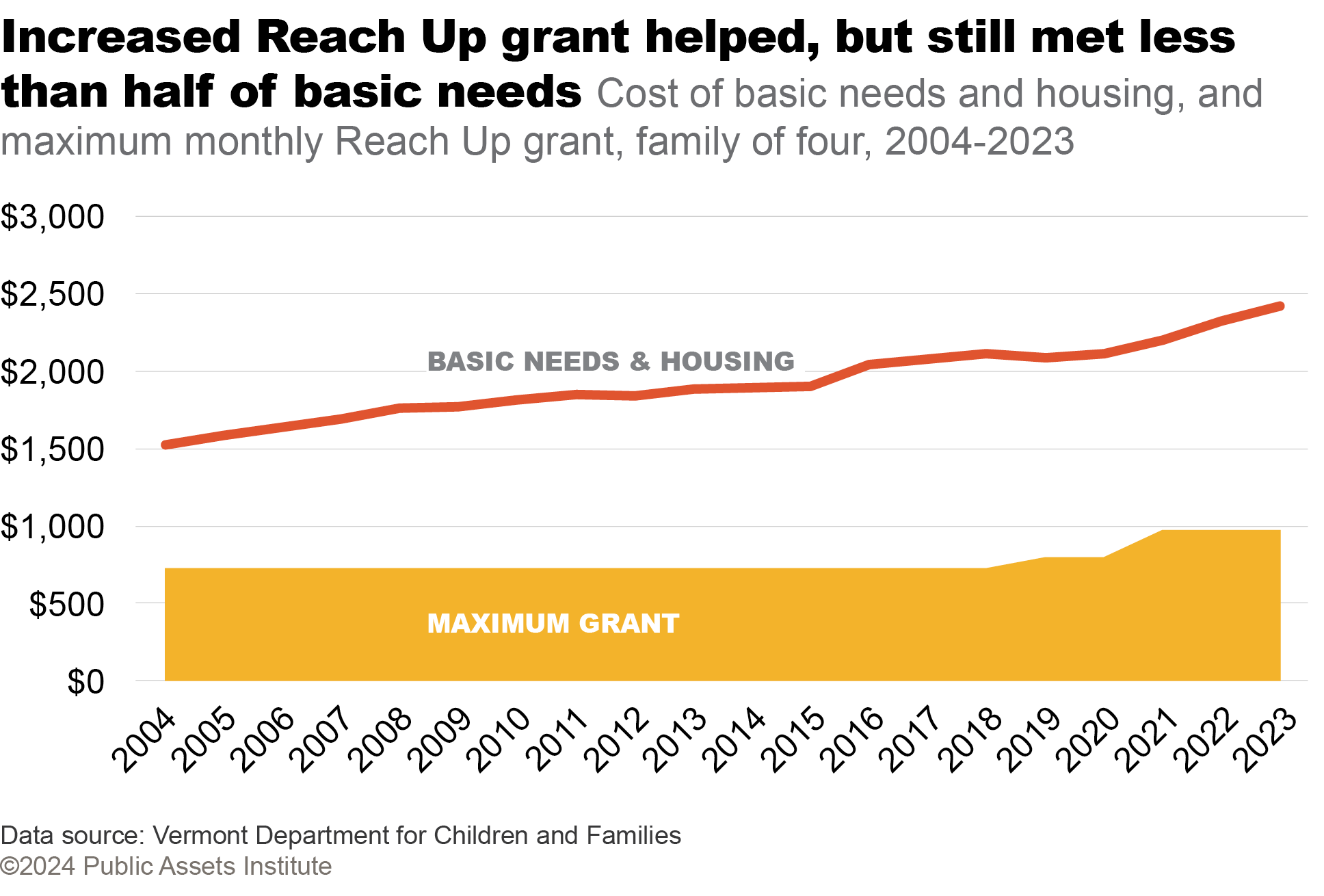
In 1996, the cash benefit in Vermont was valued at 58% of the Federal Poverty Level. The 2026 poverty guideline for a family of three is $2,277 per month. The current maximum monthly Reach Up benefit including a housing stipend for a family of three is $880, or 39% of the poverty level. For reference, “deep poverty” is defined as incomes below 50% FPL.
Cash benefits are less helpful now than they were 30 years ago. In many ways, this is by design. When President Clinton enthusiastically “ended welfare as we know it,” his administration did not end poverty. Instead, policymakers designed the TANF program to fail by reaching fewer families and eroding the cash value of the benefits received. The Urban Institute reports less than 53% of eligible Vermont families were actually receiving benefits in 2023.
National and state data confirms what families know intimately– It’s getting harder and harder to make ends meet. We know there are significant long term consequences of not having enough income to meet basic needs, especially in childhood. Longitudinal studies found that children who experience poverty have an increased risk of developing chronic diseases, cancer, and mental illness. Conversely, researchers who analyzed data on children whose mothers received the US’s first cash welfare benefit in the early 1900s found significant positive impact: longer, healthier lives, greater educational attainment and increased earnings.[1]
Looking ahead to the next 30 years, state and federal policymakers have an obligation to fix what they can and pick up the charge of ending child poverty as we know it.
As states face massive budget deficits, partially due to the tax cuts for the wealthy in HR. 1, some lawmakers are eyeing TANF funding to plug budget shortfalls. This is the wrong decision. Instead of cutting benefits or holding them stagnant as the cost of living skyrockets, and balancing the budget on the back of Vermont’s lowest income families, state lawmakers can take simple steps to improve the Reach Up program in Vermont.
Index basic needs grants to DCF’s current year cost of living calculation.
Eliminate the “ratable reduction” as it currently exists. Ensure that the benefits a family receives assures their ability to meet their children’s minimum basic needs.
Increase the housing allowance and access to housing vouchers to mitigate harm of homelessness for families with Reach Up benefits
Remove emergency housing durational limits for families experiencing homelessness.
Over the next few weeks, we will dive deeper into the experiences of Vermont families on Reach Up. We will spotlight stories and quotes from parents at Vermont’s Parent Child Centers. Send us your questions or experience with the Reach Up program. We will continue to explore the intersections of cash assistance with issues like affordability and housing instability in the coming weeks.
[1] Aizer A, Eli S, Ferrie J, Lleras-Muney A. The Long-Run Impact of Cash Transfers to Poor Families. Am Econ Rev. 2016 Apr;106(4):935-971. doi: 10.1257/aer.20140529. PMID: 28713169; PMCID: PMC5510957.