“I run out of money within the first two weeks of the month and sometimes need to skip a phone payment or car insurance payment in order to pay for urgent needs such as over the counter medication when my child is sick.”
Vermont’s Economic Services Division of the Department for Children and Families (DCF) has been administering Reach Up cash assistance for thirty years. We learned in part one of our Reach Up blog series how benefit levels have largely remained stagnant during that time.
In this second installment we will explore the impact of this budgetary neglect on very-low income children and families. Who are these Vermonters? How do they make ends meet?
Reach Up’s central purpose is to prevent children from experiencing deprivation while their parents are unable to earn enough income to cover basic needs. You must have a minor child to qualify for the program. More than two thirds of program beneficiaries are children, and the majority of these are young children under 10 years old. In 2025, Reach Up benefits supported 6266 Vermont children while DCF case managers worked with their parents (2,681 on average per month) to identify and overcome barriers to employment.
Many reported barriers noted in the annual Reach Up evaluation report are cascading impacts of unjust, short-sighted economic policies.
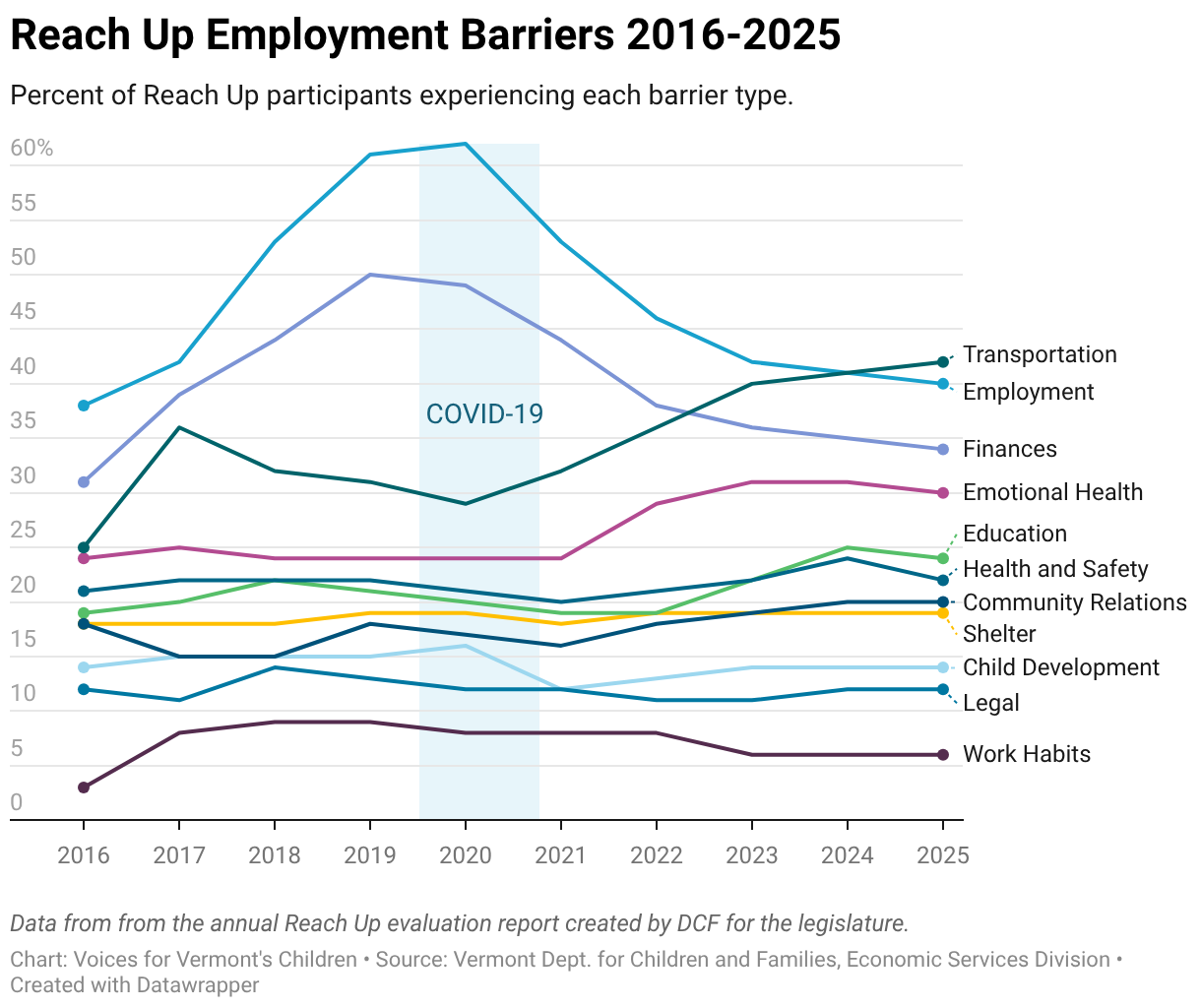
The report found:
One in four Reach Up participants identify shelter as a barrier.
About a third cite serious financial barriers like severe debt or bankruptcy.
40% named adult employment barriers like poor or no work history, and
42% say transportation barriers like a lack of driver’s license, unreliable transportation, or needing car repairs prevent them from getting or keeping a job.
More than half (52%) of Reach Up participants identified a physical or mental health barrier such as dental care, lack of primary care needed, mental health symptoms or substance misuse.
Failures in our public systems exacerbated by austerity budgeting undermine family economic security. Thousands of Vermont kids are paying the price with their health, safety and development, with both immediate and long-term implications.
Behind Caseload Data: The Storytelling Project
Last winter, Voices partnered with Parent Child Centers across Vermont to invite Reach Up recipients to share their experiences and suggestions to strengthen the program.
“Every day there is something new that comes up that throws everything off track. If a cost comes up and I don’t have the money, then I am stuck.”
The Parent Child Center network has a long history of supporting families with navigating benefits and serving as a trusted resource for families to get their needs met. Family support specialists from five Parent Child Centers across the state interviewed caregivers enrolled in Reach Up.
“I was incarcerated at a young age, and then got out and got pregnant. I had no resources whatsoever and so I enrolled in Reach Up. It was a huge support for me.”
The majority reported either a parent or child with a disability in the household. Most had been receiving Reach Up cash assistance for between one and two years. Respondents shared about the life circumstances that led to their need for cash assistance. Some lost jobs due to medical emergencies or when they were struggling to manage work with caregiving for children who are very young or have special health needs.
Making Tough Choices
A family of three receives a maximum of between $850 - $880 in Reach Up cash assistance each month.
This cash is expected to be able to cover all basic needs like housing, utilities, clothing, food, cleaning and personal hygiene supplies, and transportation costs. Even with other programs like 3SquaresVT and fuel assistance factored in, Vermont’s safety net falls far short of covering a subsistence budget.
This shortfall compels families to make incredibly challenging choices. Surveyed caregivers reported letting go of what they deem as “extras” in their grocery bills which many families would consider necessities. Families reported having to skip paying phone or internet bills.
They also reported having to pass on buying toilet paper or hand soap in order to pay for diapers and wipes. Each of these trade-offs has a consequence for child and adult health, wellbeing, and safety, and undermines the statutory goals of the program.
“I feel limited because I only get so much a month and I have to make sure it lasts, and have to make sure all three of my daughters are covered before myself. I have used the free store to get things I need like clothes. I have used a diaper bank, but now I make sure diapers and wipes are the first things I buy with my benefits. I try not to buy things that I don’t need. Like toilet paper because I already have wipes. I just go without things for myself as long as my kids are covered.”
“I have to make sacrifices for things that take [precedence] over other things; so first things are diapers/wipes. But it would be cool if I could get something like a baby monitor for him, or a new cell phone because mine is breaking. I have had to buy formula with my benefits because I ran out of WIC or food card benefits and that leaves me short for other things, like feminine hygiene products or other hygiene products, or shoes for myself.”
Financial Security Brings Safety
The storytelling project asked families whether they ever feel unsafe because of their financial situation. Half of the respondents affirmed feeling unsafe, and most of those who responded that they did feel safe still expressed that they worried about the future. Some parents received Reach Up benefits because they had recently left an abusive relationship that included financial abuse or control. Survivors of interpersonal violence expressed real worry that their financial situation left them vulnerable to future violence or control.
Losing shelter was the biggest reason for feeling unsafe, “I worry every day about being evicted and losing my housing.” Another concern was losing their children or being reported to DCF Family Services. 30% of respondents said they had already been referred or reported, “I have had DCF called on me for my house being unsafe (dirty) and I didn't have money for cleaning supplies or clean laundry.”
Recommendations & Dreams for the Future
We asked participants to share what they most want to see changed by policymakers and legislators. Participants named the uncertainty of inconsistent benefit amounts and how they feel punished for trying to get ahead.
As household income increases from a new job or business, cash assistance decreases. Voices’ interactive calculator estimates the impact of earned income, housing vouchers, and child support payments on benefits and total household resources.
No matter how you piece these patchwork supports together, families become ineligible for being “over income” well before they’re economically secure enough to cover the basic cost of living. Parents describe not being able to save or get ahead: “it feels like I am constantly digging myself out of a hole.”
“My Reach Up case manager is helping me with the process and cost of getting my LNA license reinstated. My hope is to get this quickly so I can support my children like I had been prior to needing to go on Reach Up.”
The intent of Reach Up is to provide temporary support so families can attend school, secure sustainable employment, or pursue other goals to achieve long-term economic security. The overwhelming response from participants asked about their hopes and dreams was to be financially stable and be able to not need Reach Up.
“People on Reach Up need more access to vouchers for housing or increase section 8 vouchers. My total Reach Up grant is going toward my rent as direct pay since I fell behind on rent after my accident. This leaves me with nothing for other essential needs.”